Master the Russian Alphabet: Free Printable Worksheets for Beginners
Embarking on the journey of learning Russian begins with mastering its foundational element: the Cyrillic script. For many English speakers, the sight of characters like "К", "М", and "Т" can initially seem intimidating, creating a significant barrier to entry. However, with the right tools, this script transforms from a wall of unfamiliar symbols into a logical and rewarding puzzle. Russian alphabet worksheets for beginners are precisely these tools, providing a structured and repetitive environment necessary for new learners to build muscle memory and visual recognition.
Why Worksheets Are Essential for Beginners
Unlike apps that prioritize speed, a worksheet allows for a slow, deliberate focus on form. When first encountering the letter "Р", which resembles a flipped 'P' but sounds like an 'R', a beginner needs space to trace and copy without the pressure of real-time interaction. These worksheets break down the complex alphabet into manageable chunks, often grouping letters by shape or phonetic similarity. This methodical approach reduces cognitive load, allowing students to internalize the shapes of the letters before moving on to the complex world of Russian grammar and vocabulary. The physical act of writing reinforces neural pathways far more effectively than passive reading.
Decoding the Cyrillic Script
A common misconception is that the entire Russian alphabet is entirely foreign. In reality, a significant portion of the letters look identical to their Latin counterparts, sharing the same names and sounds. Letters like "А", "К", "М", "Т", and "О" are immediately recognizable to English speakers. Worksheets specifically target this confusion and clarity by highlighting the "false friends"—letters that look similar but sound different, such as "В" (which sounds like an 'V') or "А" (which sounds like 'ah' as in 'father'). By focusing on these nuances, worksheets prevent the frustration of mispronunciation early on.


Structural Advantages of Tracing
Look and find Russian alphabet worksheets often incorporate tracing exercises that are crucial for developing proper stroke order. Russian handwriting has a specific flow, with letters like "К" and "М" built from distinct vertical and diagonal strokes. Without guidance, beginners might form these letters with inefficient, broken lines. Worksheets provide a visual map for the pencil, guiding the learner from the top to the bottom of the line. This not only results in neater handwriting but also builds the fine motor skills required to write quickly and confidently in the future.
Building Phonemic Awareness
Language learning is auditory as much as it is visual. High-quality worksheets go beyond simply displaying the letter; they integrate the sound. Next to the letter "Ш", the worksheet will include the phonetic transcription, helping the learner connect the visual symbol with the auditory output. This is vital for distinguishing between similar-looking letters like "Е" (yeh) and "Э" (eh). By prompting the student to say the sound aloud while writing, the worksheet creates a multi-sensory learning experience that cements the connection between the ear, the eye, and the hand.


Navigating the Harder Characters
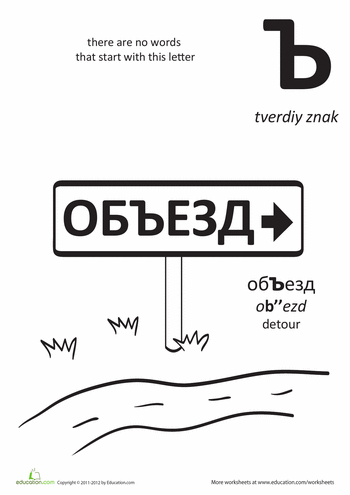
Every learner eventually encounters the "hard" and "soft" signs, represented by "Ъ" and "Ь" respectively. These signs do not make a sound on their own but act as modifiers that change the pronunciation of the preceding consonant. Worksheets dedicated to these symbols usually include clear explanations and simple word examples. For instance, seeing the contrast between "мать" (mother) and "матерь" (mother, genitive) helps illustrate the subtle but critical role these signs play. Mastering these worksheets demystifies the most complex aspect of Russian spelling.
Supplementary Learning Strategies
While worksheets are a cornerstone of learning, they are most effective when combined with other methods. To keep the process engaging, learners are encouraged to complement their worksheet study with Russian children's songs, which are excellent for memorizing the alphabet order, and labeling common household items with sticky notes. Furthermore, many modern worksheets are available in PDF format, allowing for easy printing and portability. Whether on a commute or during a coffee break, these printable resources provide consistent exposure that is key to moving the letters from short-term memory to long-term retention.




Related Articles

Master Russian Alphabet Handwriting: Free Printable PDF Worksheets
Mastering the Cyrillic script begins long before lifting a pen in actual conversation; it starts with the deliberate, practiced formation of each character...

Master Alphabet Tracing Font: Free Printable Worksheets for Perfect Letter Formation
An alphabet tracing font serves as a foundational tool in early childhood education and therapeutic settings, designed to guide the hand through the precise...

Master Telugu Tracing Letters: Free Printable Worksheets for Beginners
Mastering the Telugu script is the foundational step toward fluency in one of India’s most melodious and ancient languages. For learners, especially children...
Russian Alphabet Trace Sheet: Free Printable Worksheets For Kids
Mastering the foundational elements of any language begins with its script, and for learners of Russian, this journey starts with the distinct visual...
Master the Russian Alphabet: Free Tracing Sheets for Beginners
Mastering the foundational elements of any language begins with the written form, and for those embarking on the journey of Russian, the first essential step...
Master Russian Handwriting: Free Printable Worksheets for Practice
Mastering the art of Russian penmanship requires consistent practice, and high-quality russian handwriting worksheets are the most effective tool for...