Hexagon Shape Worksheets: Fun Geometry Activities for Kids
Hexagon shape worksheets represent a foundational tool in early childhood education and elementary mathematics, offering a structured pathway for young learners to grasp complex geometric concepts. These printable resources move beyond simple identification, transforming the hexagon from a mere six-sided polygon into an engaging puzzle that enhances spatial reasoning and fine motor skills. By incorporating these exercises into lesson plans or at-home activities, educators and parents provide children with a tactile and visual method to understand symmetry, pattern recognition, and the properties of 2D shapes.
Why Hexagons Are Critical in Early Education
The significance of the hexagon extends beyond its presence in honeycombs; it is a critical component of standardized curricula for kindergarten and first grade. Unlike basic circles or squares, the hexagon requires students to differentiate between sides and angles, fostering analytical thinking. Worksheets focusing on this shape help children develop the vocabulary necessary to describe geometric attributes, such as vertices and edges. This early introduction builds a robust foundation for more advanced topics in geometry, fractions, and even chemistry, where the molecular structure of graphene is based on hexagonal lattices.
Identifying and Differentiating Shapes
A primary objective of any hexagon shape worksheet is to train the eye to recognize the shape in various orientations and contexts. Children learn to distinguish a hexagon from an octagon or a trapezoid by counting the six distinct sides and corners. These worksheets often include a mix of polygons, prompting students to sort, circle, or color only the hexagons. This activity sharpens visual discrimination, a skill that is vital for reading fluency and mathematical problem-solving, ensuring students can isolate specific criteria from a field of variables.


Tracing and Drawing Practice
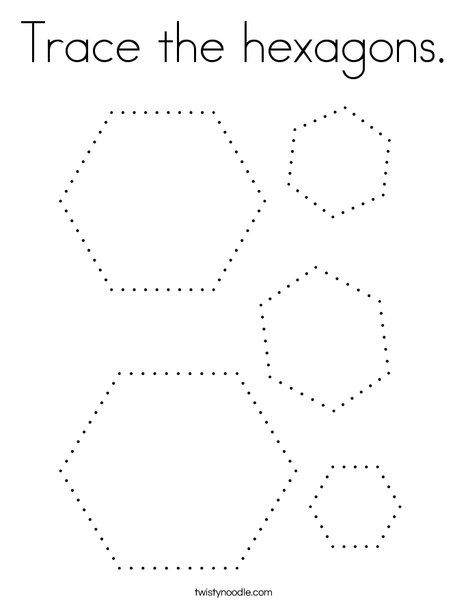
Motor skill development is seamlessly integrated into the use of these worksheets through tracing exercises. Students begin by tracing the outline of a hexagon, which helps them understand the directional strokes required to form the shape. Progressing to drawing the shape independently encourages spatial planning and hand-eye coordination. Mastering the hexagon is often a gateway to writing more complex letters, as the strokes required—such as diagonal lines and consistent angles—are similar to those used in cursive writing.
Advanced Applications and Pattern Recognition
As students advance, hexagon shape worksheets evolve to include tessellation and pattern activities. Learners explore how hexagons fit together without gaps, a concept crucial for understanding tiling and mosaic art. These exercises introduce the idea of symmetry lines, with students drawing lines of reflection or identifying rotational symmetry. By manipulating these shapes mentally and on paper, children develop a spatial intelligence that applies to fields ranging from architecture to graphic design.


| Skill Area | Benefit of Hexagon Worksheets | Real-World Connection |
|---|---|---|
| Geometry | Identifies sides, vertices, and angles | Honeycombs, soccer balls, and nuts/bolts |
| Fine Motor Skills | Improves pencil grip and control | Prepares for writing and drawing |
| Problem Solving | Encourages sorting and classification | Organizing data and logical reasoning |
Integrating Technology and Creativity
Modern hexagon shape worksheets often blend traditional pencil-and-paper tasks with digital interaction. Educators might use interactive whiteboards to demonstrate the shape, followed by printable drills for reinforcement. Furthermore, these worksheets can serve as templates for art projects, where students cut out hexagons to create collages or decorate them to form stained-glass-like art. This cross-curricular approach ensures that learning about the hexagon is not confined to the math page but becomes a vibrant, multi-sensory experience.
Selecting the Right Worksheet for Your Learner
When choosing hexagon shape worksheets, it is essential to consider the age and skill level of the child. For toddlers and preschoolers, large-print sheets with simple tracing lines are most effective. For older children, worksheets that require them to calculate the area of a hexagon or divide the shape into fractions are more appropriate. The best worksheets strike a balance between instruction and play, incorporating puzzles, mazes, and dot-to-dot activities that keep the child engaged while solidifying their understanding of this versatile geometric shape.




Related Articles

Grade 2 Shape Worksheets: Fun Geometry Activities for Kids
Grade 2 shape worksheets represent a critical bridge between basic preschool geometry and the more complex mathematical concepts encountered in later...

Octagon Shape Worksheets: Printable Geometry Activities for Kids
An shape octagon worksheet serves as a foundational tool for early learners navigating the world of geometry. This specific resource focuses on the octagon, a...
Hexagon Shape Worksheets for Kindergarten: Fun Geometry Activities
Hexagon shape worksheets for kindergarten represent a foundational tool in early childhood geometry education. These specific resources introduce young...

Quadrilateral Cut and Paste Worksheets: Fun Shape Activities for Kids
Quadrilateral cut and paste worksheets represent a foundational tool in early geometry education, providing a tactile bridge between abstract shapes and...

Fun Shape Worksheets for Pre K Kids – Free Printable Activities
Shape worksheets for pre K children represent a foundational pillar in early childhood education, bridging the gap between playful exploration and structured...
Fun Shape Worksheets for Grade 3 – Geometry Practice Activities
Third grade marks a pivotal shift in a young mathematician’s journey, where abstract symbols begin to transform into tangible understanding. Shape worksheets...