Fun Doubles Worksheets: Engaging Math Practice for Kids
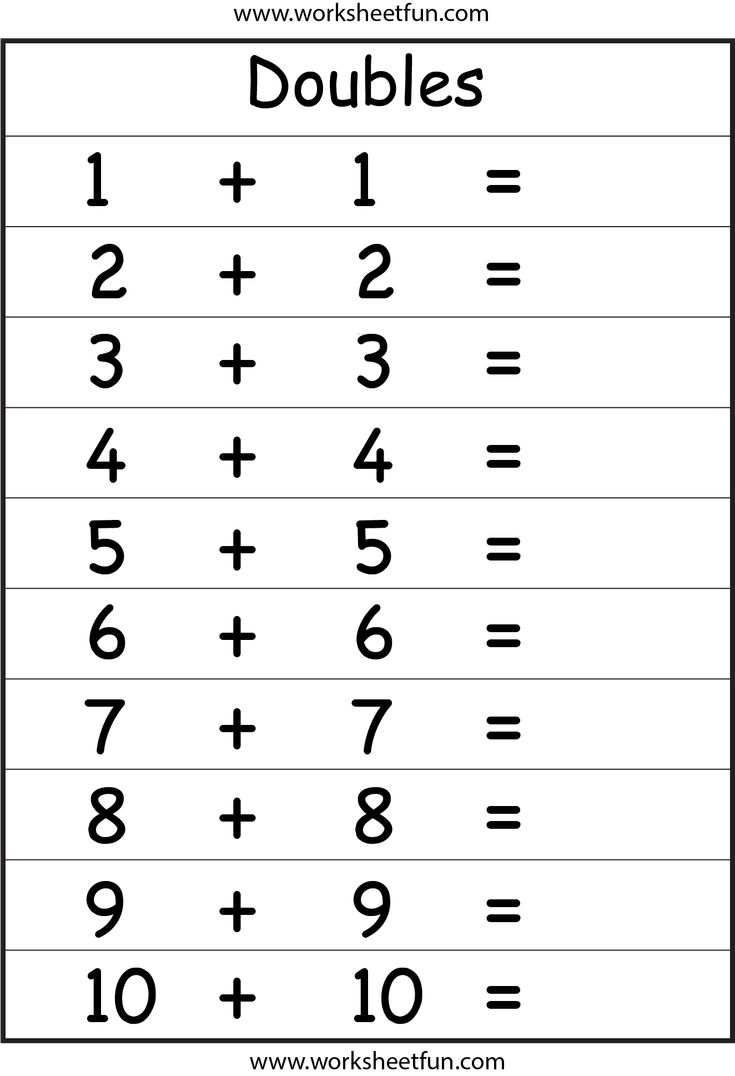
Worksheet fun doubles transforms the often-drill-heavy practice of multiplication into an engaging and visually stimulating exercise for young learners. Instead of rote repetition, these activities use patterns, games, and creative prompts to help children grasp the concept of doubling numbers, which serves as a fundamental building block for arithmetic fluency. By presenting the doubles facts—such as 2+2, 3+3, and 8+8—in an interactive format, educators and parents can significantly reduce math anxiety and build confidence.
Why Doubles Facts Matter in Early Math
Doubles are more than just a shortcut; they are a critical component of numerical literacy that supports mental math and number sense. When children memorize that 5+5 equals 10, they create a cognitive anchor that helps them solve more complex problems, such as 5+6 or 5+7, by using the doubles plus one strategy. This automaticity frees up working memory, allowing students to focus on higher-level problem-solving rather than getting stuck on basic calculations. Mastery of these facts is directly linked to success in later mathematical concepts, including multiplication and division.
The Psychology of Playful Learning
Children are naturally curious, and worksheet fun doubles leverage this intrinsic motivation by incorporating elements of surprise, color, and narrative. When a worksheet feels like a puzzle or a game rather than a test, the brain releases dopamine, which enhances focus and memory retention. Activities that involve mazes, connect-the-dots, or decoding messages using doubles encourage students to practice without realizing they are engaged in rigorous drill and skill. This shift in perspective is key to fostering a lifelong love for mathematics.


Interactive Worksheet Activities for Doubles
Educators seeking to implement worksheet fun doubles can utilize a variety of dynamic templates that go beyond simple number lists. These resources are designed to cater to different learning styles, whether a student is visual, kinesthetic, or auditory. Below is a breakdown of common activity types found in effective doubles worksheets:
- Doubles Flip Books: Students solve problems on one side of a flap and reveal the answer on the other, creating an interactive self-checking mechanism.
- Color-by-Number Doubles: Correctly solving a doubles equation reveals a specific color code, ultimately unveiling a hidden picture or pattern.
- Doubles Bingo: Calling out sums (like "Four plus four is eight") prompts students to cover the corresponding doubles equation on their cards.
- Story Problems: Integrating doubles into relatable narratives, such as "If you have two groups of three apples, how many do you have in total?"
Visual Design and Cognitive Load
The effectiveness of worksheet fun doubles is heavily influenced by its design. Cluttered pages can increase cognitive load, causing frustration and distraction. High-quality worksheets utilize ample white space, clear fonts, and consistent color schemes to guide the eye naturally across the page. Visual aids, such of arrays of objects or number lines, help students see the quantity behind the numbers, bridging the gap between abstract symbols and concrete understanding.


Differentiation for Diverse Learners
A truly engaging worksheet fun doubles resource includes layers of difficulty to accommodate a mixed-ability classroom. For struggling learners, a worksheet might include a number line or a hundreds chart as a supportive scaffold. For advanced students, the same activity might present missing addend problems (e.g., 4 + ___ = 8) or challenge them to identify patterns in the sums. This tiered approach ensures that every student is appropriately challenged without feeling overwhelmed or bored.
Integrating Technology and Hands-On Learning
While traditional paper worksheets have their place, the modern approach to worksheet fun doubles often blends physical materials with digital interaction. Teachers might use QR codes on worksheets that link to short videos explaining the strategy or to self-grading online quizzes. Furthermore, pairing worksheets with hands-on manipulatives—such as doubling blocks, beads, or snap cubes—allows students to physically group items, reinforcing the concept that doubling means making two equal groups.
Measuring Success and Building Fluency
The ultimate goal of worksheet fun doubles is to move students from counting on their fingers to recalling answers instantly. Progress monitoring can be as simple as timing how quickly a student completes a page correctly or observing their ability to explain their reasoning. Mastery is not just about speed; it is about accuracy and the flexibility to apply the knowledge. When students can confidently double numbers up to 10, they lay the essential groundwork for tackling more complex arithmetic with ease and efficiency.


Related Articles

Fun Multiplication Worksheets PDF – Engaging Math Practice for Kids
For educators and parents navigating the early stages of mathematical development, finding engaging tools is essential. A fun multiplication worksheets PDF...

Fun Math Games for Grade 3 Worksheets Printable – Engaging Practice for Kids
For parents and educators navigating the early stages of mathematical development, finding engaging resources is key. Math games for grade 3 worksheets...

Adding 3 Digit Numbers Coloring Worksheet – Fun Math Practice for Kids
Mastering the addition of three-digit numbers is a fundamental milestone in a student's mathematical journey, and a 3 digit numbers coloring worksheet provides...

Free Division Math Worksheets – Fun Practice for Kids
Mastering arithmetic fundamentals is the cornerstone of mathematical confidence, and division stands as one of the most critical operations for students to...

Division Worksheet Class 1: Fun Math Practice for Kids
Mastering the fundamentals of arithmetic is the cornerstone of a strong educational foundation, and for young learners in their first year of formal schooling...

Counting Butterflies Worksheets: Fun Math Practice for Kids
Counting butterflies worksheets present a unique intersection of early childhood education and nature appreciation, offering a structured yet colorful approach...