Hexagon Tracing Worksheets: Fun Geometry Practice for Kids
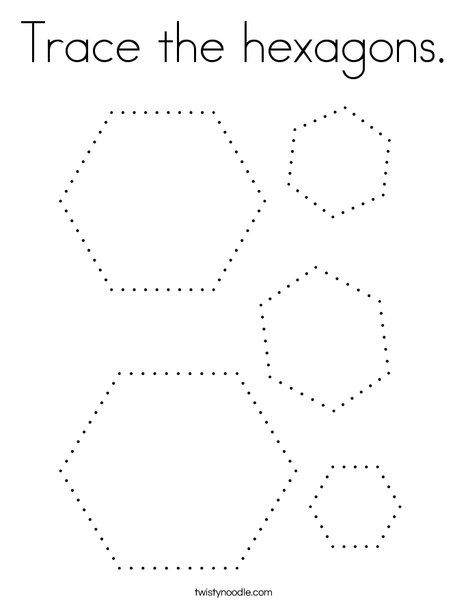
Tracing hexagon worksheet activities provide a foundational platform for developing spatial reasoning and geometric literacy in young learners. This specific exercise focuses on the hexagon, a six-sided polygon that appears frequently in nature, from honeycombs to snowflakes, making it a particularly engaging shape for early education. By guiding a pencil along the outlined paths, children establish crucial neural connections between visual perception and motor control.
Understanding the Pedagogical Value
The primary objective of a tracing hexagon worksheet extends far beyond simple line replication. It serves as a critical pre-writing exercise that strengthens the fine motor skills necessary for cursive handwriting and drawing. The angular vertices and straight edges of the hexagon challenge a child's hand-eye coordination, requiring controlled movements that build the small muscles in the hand and fingers. This deliberate practice reduces the frustration often associated with early writing tasks by isolating the mechanics of stroke formation.
Cognitive and Geometric Benefits
Beyond motor skills, these worksheets facilitate deep cognitive processing regarding geometric properties. As students trace, they implicitly learn that a hexagon is defined by six vertices (corners) and six edges (sides). This kinesthetic experience helps solidify abstract concepts like angles and symmetry. Unlike passive observation, tracing transforms geometry from a theoretical subject into a tangible activity, allowing children to physically map the shape’s structure onto their muscle memory, which enhances long-term retention and recognition.


Implementing the Tracing Activity
Effective implementation of a tracing hexagon worksheet requires more than merely handing a child a pencil. Educators and parents should begin by verbally identifying the shape and discussing its features before the tracing begins. This primes the student to look for specific characteristics, such as the parallel lines and the convergence of lines at the points. To accommodate different developmental stages, it is beneficial to use worksheets that offer varying levels of complexity, from dotted lines for beginners to faded lines for intermediate learners.
Strategies for Differentiation
To ensure the activity remains accessible and challenging for all students, differentiation is key. For younger children or those new to writing, providing a larger worksheet with thick, bold lines can reduce visual overwhelm and make the task more manageable. Conversely, advanced learners can benefit from worksheets that require them to trace the hexagon multiple times to form a pattern or tessellation, or to draw the shape freehand immediately after tracing to assess retention. Incorporating color-coding, such as tracing the top half of the shape in one color and the bottom half in another, can also add a layer of focus and engagement.


Integration into Broader Learning Contexts
A tracing hexagon worksheet does not exist in a vacuum; it is most powerful when integrated into a broader thematic unit on shapes, patterns, or the natural world. Teachers can connect the activity to science lessons by showing how bees use hexagonal wax cells to store honey, providing a real-world context for the abstract shape. Similarly, art classes can utilize the traced hexagon as a building block for creating geometric mosaics or designing kaleidoscopic patterns, bridging the gap between mathematical precision and artistic expression.
Progression to Advanced Skills
Mastery of the traced hexagon serves as a stepping stone to more advanced geometric and analytical tasks. Once a student can confidently trace and draw the shape, the focus can shift to identifying hexagons within complex images or environments. This progression moves the skill from the concrete operational stage to the abstract reasoning stage. Furthermore, the understanding of the hexagon’s properties lays the groundwork for future mathematics concepts, including fractions (dividing shapes into equal parts) and area calculations, demonstrating the enduring value of this seemingly simple tracing exercise.


Related Articles

A to Z Letter Tracing Worksheets: Free Printable Practice for Kids
Mastering the foundational elements of language is often the first step in a child's educational journey, and few tools are as effective as a dedicated...

Free Tracing Worksheet Printables for Kids – Pre-Writing Practice and Letter Formation
For educators and parents constantly seeking high-quality, no-cost educational tools, the search for a reliable tracing worksheet free resource is a common...

Tamil Letters Tracing Worksheet: Free Printable Practice for Kids
Mastering the foundational elements of language is a journey that begins with the smallest details, and for children embarking on the path of reading and...

Free Letter B Dot Worksheet – Tracing & Coloring Practice for Kids
Parents and educators searching for effective resources to support early literacy development often encounter the search term "letter b dot worksheet free."...

Fun Number Worksheets 1-20: Tracing, Counting & Writing Practice
Mastering the fundamentals of arithmetic begins with a solid grasp of the numbers that form the bedrock of all mathematics. The worksheet about numbers 1 20...

Interactive Shapes Online Worksheet: Fun Geometry Practice for Kids
An online shapes worksheet provides a dynamic platform for learners to explore geometric concepts through interactive exercises. These digital resources...