Master Tracing 3 Letter Words: Free Printable Worksheets
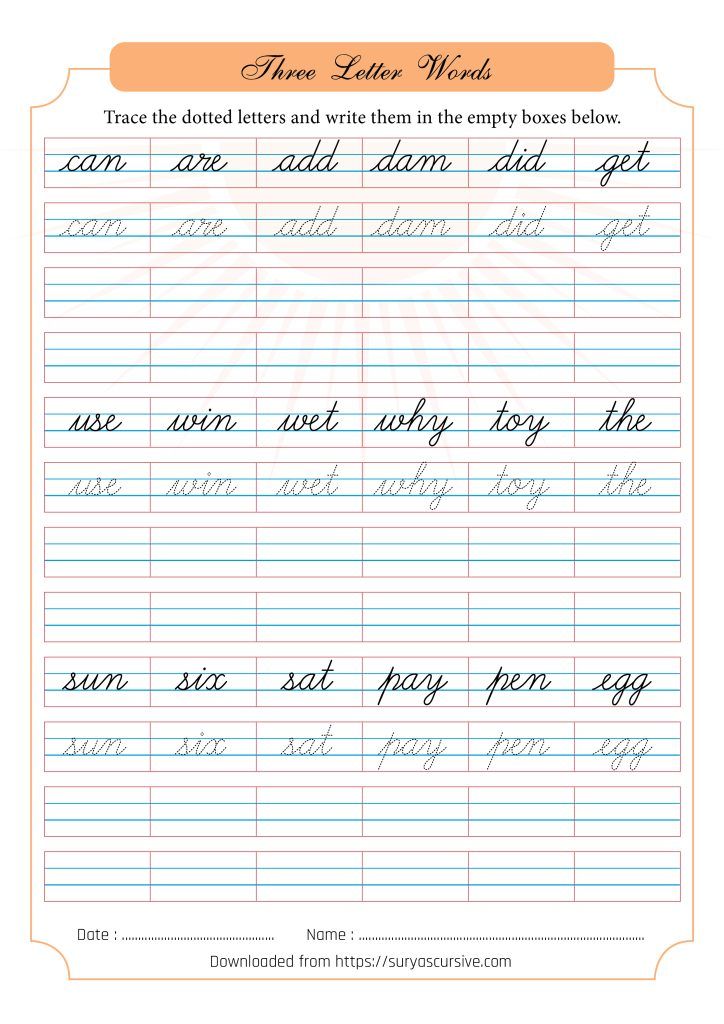
For parents and educators navigating the early stages of literacy development, three letter words tracing worksheets represent a foundational tool. These simple yet effective exercises bridge the gap between recognizing letters and forming words, providing a structured path for young learners. By focusing on the most basic building blocks of the English language, these worksheets help children connect letter shapes with their corresponding sounds in a tactile and engaging way.
The Core Value of Three Letter Words
The significance of three letter words cannot be overstated in the journey of early reading. Words like "cat," "dog," "run," and "sun" are not just common; they are the essential vocabulary that allows a child to decode their first stories. Tracing these words transforms abstract letters into concrete shapes, reinforcing muscle memory and improving pencil control. This practice ensures that children move beyond mere recognition to actual production, fostering confidence in their emerging writing skills.
Design Elements that Drive Learning
Effective three letter words tracing worksheets are thoughtfully designed to align with child development principles. A high-quality worksheet will feature clear, large fonts with distinct starting points indicated by dots or arrows to guide the pencil movement. Visual aids, such as an image of a cat next to the word "cat," provide context and reinforce the meaning of the text. The spacing between lines and letters is crucial, preventing visual crowding and helping children form letters with consistent size and alignment.


Progressive Difficulty Levels
To cater to different skill levels, worksheets are often structured in stages. Beginners might start with single letter formation or tracing individual vowels and consonants. As proficiency grows, sheets introduce simple CVC (consonant-vowel-consonant) words. Advanced versions might include rhyming exercises or words with double letters, ensuring that the learning curve remains challenging but achievable without causing frustration.
Integrating Worksheets into Learning Routines
The true power of these worksheets is realized when they are integrated into a balanced literacy routine. They work best when used as a supplement to phonics instruction and read-aloud sessions, rather than as isolated drills. A short, focused session of 10 to 15 minutes allows children to practice the physical act of writing while the phonics lesson provides the auditory context. This multi-sensory approach—seeing the word, saying the sounds, and then forming the letters—cements the learning far more effectively than any single method alone.


Tips for Educators and Parents
- Use verbal cues: Say the sound of each letter as the child traces it ("/c/ /a/ /t/").
- Focus on proper pencil grasp early to prevent the need for correction later.
- Celebrate effort over perfection to keep the child engaged and motivated.
- Keep the sessions varied by mixing different worksheets to maintain interest.
Beyond the Worksheet: Real-World Application
The ultimate goal of mastering three letter words is fluency in real-world contexts. As children become comfortable tracing and writing these terms, the focus should shift to recognizing them in books and using them in conversation. Encourage children to spot "bat" in a story or "red" on a stop sign. This transition from the worksheet to the world transforms a simple tracing exercise into a meaningful step toward genuine literacy and communication.




Related Articles

Master Alphabet Tracing Font: Free Printable Worksheets for Perfect Letter Formation
An alphabet tracing font serves as a foundational tool in early childhood education and therapeutic settings, designed to guide the hand through the precise...

Three Letter Words Worksheets with Pictures PDF: Free Printable Pack
Mastering the fundamentals of language often starts with the smallest building blocks, and three letter words represent a crucial milestone in a child's...

Master O Vowel 3 Letter Words: Free Printable Worksheets
Mastering short vowel sounds is a foundational step in early literacy, and the "o vowel 3 letter words worksheets" are a targeted tool designed to solidify...

Free Cursive Writing Worksheets PDF: Master 3-Letter Words 빠르게 배우기
Mastering the fluid connection of letters is the foundation of legible and confident handwriting, and few tools are as effective for developing this skill as...

Free Uppercase Letter Tracing Worksheets – Printable Alphabet Practice Sheets
Mastering the fundamentals of written communication begins with the building blocks of the alphabet, and for many young learners, this journey starts with...

Free Printable Letter W Worksheets: Tracing, Writing & Recognition
Mastering the foundational elements of written language often begins with the simplest of tools, and for the letter W, this takes the form of specialized...