Tracing Three Letter Words: Fun Worksheet for Kids
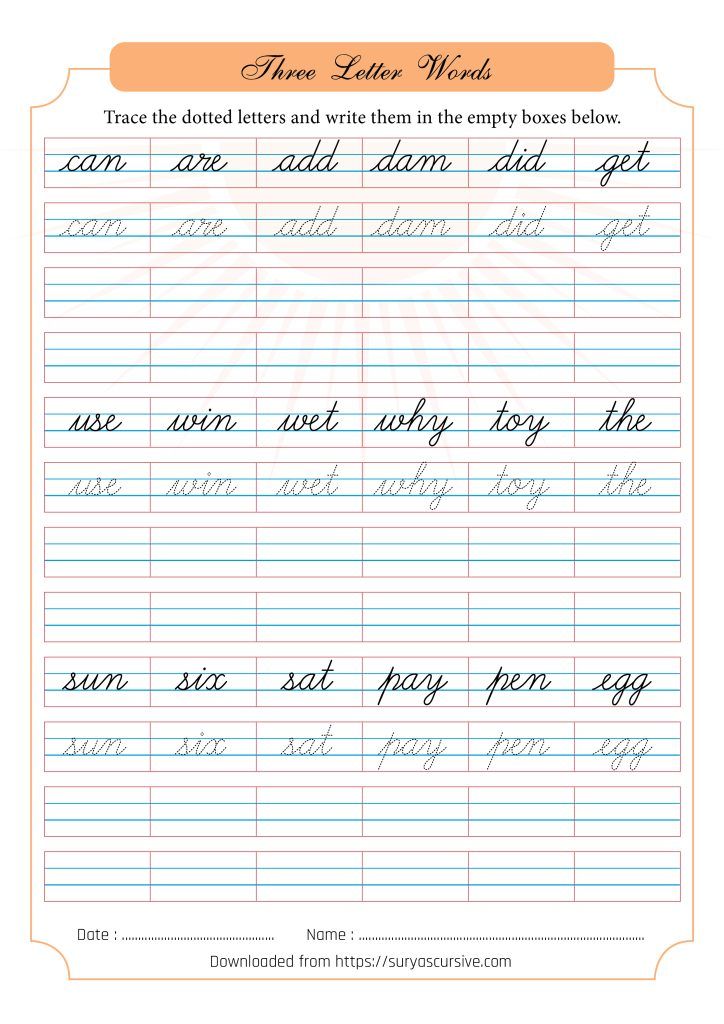
Mastering the fundamentals of written language begins with the smallest components, and few exercises are as effective for early learners as the three letter words tracing worksheet. This specific tool targets the crucial stage where children transition from recognizing letters to forming simple words. By focusing on consonant-vowel-consonant structures, these worksheets provide a scaffolded approach to decoding and writing.
The Educational Value of Three Letter Words
The prominence of the three letter words tracing worksheet in kindergarten and preschool curricula is no accident. These phonetically simple terms, such as "cat," "run," or "sun," represent some of the first words children decode and spell. The act of tracing transforms abstract letter shapes into motor memories, bridging the gap between cognitive recognition and physical writing. This process reinforces phonemic awareness, helping children map specific sounds to their corresponding letters.
Structural Simplicity for Foundational Learning
Why three letters specifically? This length strikes the perfect balance between being approachable for novice writers and complex enough to convey distinct meaning. Longer words can overwhelm developing fine motor skills, while single letters lack the context of word formation. The CVC (consonant-vowel-consonant) pattern inherent in most three letter words mirrors the natural progression of language acquisition, making the three letter words tracing worksheet an intuitive starting point for reading readiness.


Design Elements of Effective Tracing Sheets
Not all tracing materials are created equal, and the design of a quality three letter words tracing worksheet incorporates specific pedagogical strategies. High-quality versions feature distinct, dotted lines for tracing and ample space for freehand replication. Visual cues, such as corresponding illustrations of a "hat" or "dog," provide context and aid in retention without relying solely on text.
- Guided stroke order to ensure proper letter formation.
- Progressive difficulty, moving from single-word practice to simple sentence strips.
- Inclusion of both uppercase and lowercase letter combinations.
- Interactive elements like coloring sections to maintain engagement.
Fine Motor Skill Development
Beyond literacy, these worksheets are instrumental in developing the pincer grasp and hand-eye coordination required for future writing proficiency. The repetitive motion of tracing lines and curves strengthens the small muscles in the hand and fingers. This physical practice is essential before a child can confidently space letters and maintain consistent letter size on unlined paper.


Implementing the Worksheet in Learning Routines
For educators and parents, integrating the three letter words tracing worksheet effectively requires more than simply handing out paper. Introducing the target word verbally first, followed by sounding out each letter, creates a multi-sensory learning experience. Demonstrating the starting point for each stroke ensures the child begins with the correct formation, preventing the need to unlearn poor habits later on.
Maximizing Retention Through Variety
While repetition is key, varying the application of the worksheet prevents boredom and deepens understanding. After tracing, children can benefit from dictation exercises where the adult says the word and the child writes it. Alternatively, using the worksheet as a template for creating a classroom word wall turns a solitary activity into a collaborative learning environment. This versatility ensures the simple exercise of tracing remains dynamic and effective.




Related Articles

Fun Letter C Objects Worksheet for Kids – Tracing & Identifying Words
Mastering the alphabet is a foundational skill that unlocks a world of reading and writing for young learners, and understanding the distinct sound and shape...
Fun 3 Letter Words Worksheet: Free Printable Practice For Kids
Mastering the fundamentals of early literacy often begins with the simplest building blocks, and few tools are as effective as the worksheet for three letter...

Three-Letter Words with E in the Middle: Fun Worksheet for Kids
Mastering the intricacies of the English language often involves a deep dive into its structural components, and one of the most effective exercises for early...

Free Tracing Worksheet Printables for Kids – Pre-Writing Practice and Letter Formation
For educators and parents constantly seeking high-quality, no-cost educational tools, the search for a reliable tracing worksheet free resource is a common...

Free Letter B Dot Worksheet – Tracing & Coloring Practice for Kids
Parents and educators searching for effective resources to support early literacy development often encounter the search term "letter b dot worksheet free."...

A to Z Letter Tracing Worksheets: Free Printable Practice for Kids
Mastering the foundational elements of language is often the first step in a child's educational journey, and few tools are as effective as a dedicated...