Master 3 Letter Words: Free Practice Sheets for Kids
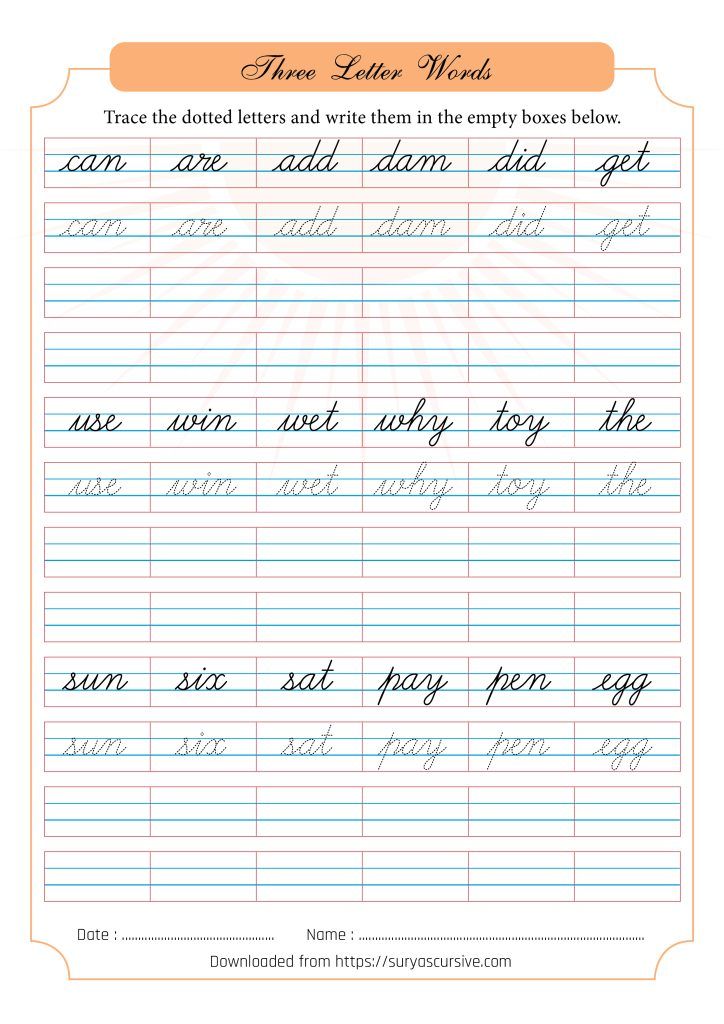
Mastering the building blocks of language often begins with the simplest units, and for early readers, few tools are as effective as focused three letter words practice sheets. These compact exercises isolate the fundamental phonetic patterns that form the backbone of reading fluency. By concentrating on consonant-vowel-consonant structures, children can decode sound combinations without the complexity of longer words. This targeted approach builds confidence and establishes a critical foundation for more advanced literacy skills.
Why Three Letter Words Matter in Early Education
The significance of CVC (consonant-vowel-consonant) words cannot be overstated in the developmental journey of a young learner. These short, phonetically regular words allow children to apply letter-sound correspondence rules consistently. Because they are predictable, three letter words practice sheets reduce cognitive load, enabling students to focus purely on decoding rather than memorization. Success with these simple terms translates directly to the ability to tackle more complex vocabulary with greater independence and speed.
The Science Behind Short Word Recognition
Educational research supports the use of structured phonics practice, particularly with high-frequency short words. These words often feature heavily in early readers, meaning a student’s ability to recognize them instantly affects comprehension and enjoyment of text. A practice sheet provides the repetitive exposure necessary to move a word from short-term memory to sight-word recognition. This automaticity frees up mental energy for understanding context and meaning, rather than laboring over individual sounds.


Structural Benefits of Targeted Practice
Three letter words practice sheets offer a unique structural advantage by breaking down the English language into manageable components. Rather than overwhelming a child with the entire alphabet, these sheets focus on specific vowel sounds paired with consistent consonants. This modular approach allows educators and parents to address specific gaps in a child’s knowledge. Whether reinforcing the short "a" sound in "cat" and "sat" or the "m" sound in "map" and "mat," the practice is precise and intentional.
| Vowel Center | Example Words | Skill Focus |
|---|---|---|
| A | Cat, Sat, Bat, Pat | Short A Sound |
| E | Pen, Ten, Ben, Hen | Short E Sound |
| I | Bit, Sit, Pit, Lit | Short I Sound |
Progressive Difficulty
Well-designed sheets do not simply repeat the same words; they evolve in complexity. Initial exercises might focus on identification, asking a child to point to the letter "D" in "dog." Subsequent sheets will shift to phonemic manipulation, such as changing "cat" to "cot" by swapping one letter. This progression ensures that the practice sheet remains a dynamic learning tool rather than a static worksheet, continually challenging the developing mind.


Practical Applications for Home and Classroom
In a classroom setting, these sheets serve as invaluable resources for guided reading groups or independent station work. They provide a quiet, focused activity that reinforces the lesson taught during direct instruction. For parents engaging in home schooling or supplemental learning, they offer a straightforward way to structure a daily practice routine. The low cost of creation—often just a simple printout—makes them an accessible tool for any budget dedicated to a child’s academic success.
Maximizing Engagement
To prevent these exercises from feeling like rote memorization, integrating gamification is key. Turning the completion of a three letter words practice sheet into a race against the clock, a bingo game, or a partner activity can dramatically increase motivation. The goal is to associate the repetition with positive reinforcement and a sense of accomplishment. When a child sees the immediate application of these skills in reading a favorite storybook, the practice transforms from a task into a meaningful step toward literacy.




Related Articles
Fun 3 Letter Words Worksheet: Free Printable Practice For Kids
Mastering the fundamentals of early literacy often begins with the simplest building blocks, and few tools are as effective as the worksheet for three letter...

Free Cursive Writing Worksheets PDF: Master 3-Letter Words 빠르게 배우기
Mastering the fluid connection of letters is the foundation of legible and confident handwriting, and few tools are as effective for developing this skill as...

Free Tracing Worksheet Printables for Kids – Pre-Writing Practice and Letter Formation
For educators and parents constantly seeking high-quality, no-cost educational tools, the search for a reliable tracing worksheet free resource is a common...

Free Preschool Coloring Pages Letter B – Fun alphabet coloring sheets for kids
Preschool coloring pages letter B serve as a foundational tool in early childhood education, transforming abstract letter recognition into a tangible, hands-on...

Free Letter B Dot Worksheet – Tracing & Coloring Practice for Kids
Parents and educators searching for effective resources to support early literacy development often encounter the search term "letter b dot worksheet free."...

Master Beautiful Hand Lettering: Free Practice Sheets for Perfecting Your Fonts
Hand lettering fonts practice sheets are the foundational training wheels for anyone serious about mastering the art of beautiful script. Whether you are a...