Master 3 Letter Word Spelling Worksheets – Fun & Easy Practice
For educators and parents seeking effective tools to build early literacy, three letter word spelling worksheets stand as a fundamental resource. These concise exercises target the essential phonics skills required for reading fluency, helping young learners bridge the gap between individual letter sounds and simple word recognition. By focusing on the most basic structural elements of the English language, these worksheets provide a manageable and confidence-building entry point into the world of written communication.
The Foundational Value of Three Letter Words
The significance of mastering three letter words cannot be overstated, as they form the bedrock of a child’s reading vocabulary. Words like "cat," "run," and "sun" are not arbitrary; they follow consistent CVC (consonant-vowel-consonant) patterns that are easy to decode. Worksheets dedicated to these structures allow children to apply phonics rules in a concrete way, reinforcing the alphabetic principle—the idea that letters represent specific sounds. This consistent pattern recognition is the crucial first step toward decoding more complex and unfamiliar words independently.
How Worksheets Reinforce Phonemic Awareness
Effective three letter word spelling worksheets are designed to sharpen phonemic awareness, which is the ability to hear, identify, and manipulate individual sounds in spoken language. Activities often isolate specific vowel sounds or beginning consonant blends, guiding students to map these auditory signals onto visual letters. For example, a worksheet might focus solely on short "a" sounds (as in "bat," "cap," "sat"), forcing the brain to distinguish subtle auditory differences. This targeted practice strengthens the neural pathways necessary for accurate and efficient word retrieval during reading.


- Provides structured, low-stakes practice that reduces the anxiety of learning to read.
- Offers immediate visual feedback, helping children self-correct their spelling attempts.
- Builds the fine motor skills required for writing through repeated letter formation.
- Creates a scaffold for future learning, preparing students for longer words and complex grammar.
Designing Effective Learning Activities
Not all worksheets are created equal, and the most effective designs move beyond simple rote copying. High-quality three letter word spelling worksheets incorporate a variety of engaging activities that cater to different learning styles. Visual learners benefit from images that correspond to the words, while kinesthetic learners thrive when cutting and pasting letters or tracing textured words. A balanced worksheet will combine tracing, blank writing, and matching exercises to ensure a comprehensive understanding of the spelling structure.
| Activity Type | Description | Benefit |
|---|---|---|
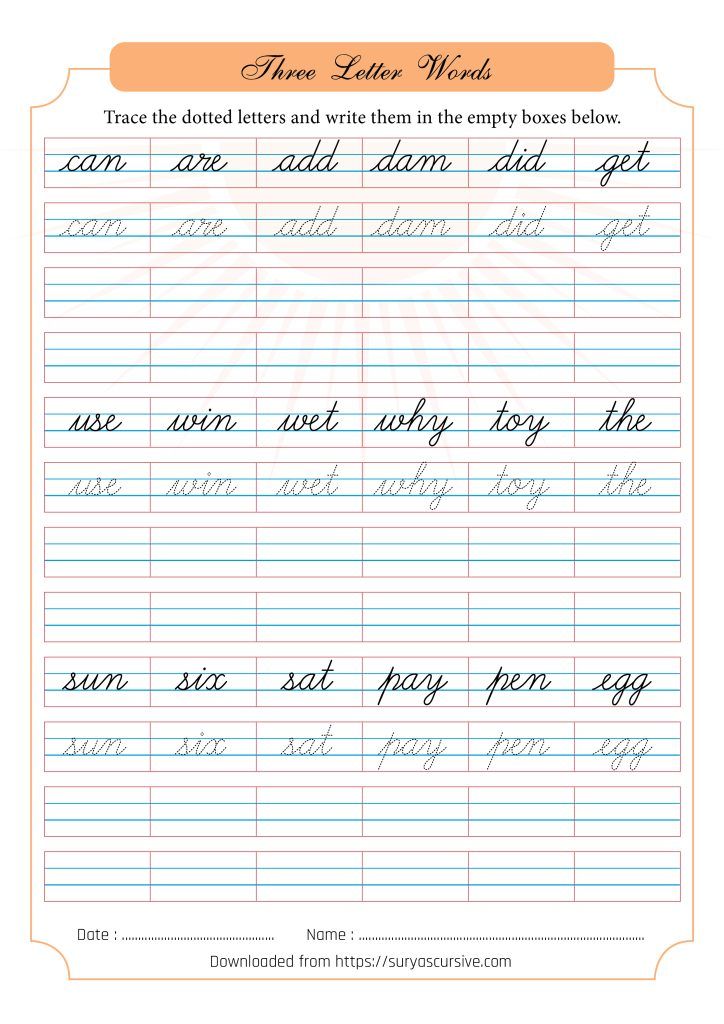
| Trace and Write | Students first trace the word, then write it independently. | Builds muscle memory and corrects letter formation. |
| Fill in the Blank | Students are given a picture and must write the missing word (e.g., c_t). | Encourages phonetic decoding and letter recall. |
Integrating Worksheets into a Broader Curriculum
To maximize the impact of three letter word spelling worksheets, they should be viewed as one component of a holistic literacy strategy. These worksheets work best when they are integrated with hands-on activities, such as using letter magnets on a whiteboard or engaging in guided oral reading of simple books. The goal is to create a multi-sensory learning experience where the abstract symbols on the page are connected to tangible sounds and objects. This contextual learning ensures that the skills learned on the worksheet are transferable to real-world reading scenarios.


As students progress, the complexity of the worksheets should evolve to include digraphs and short vowel patterns, ensuring that the foundation established with basic three letter words supports ongoing development. Teachers and parents should view these worksheets not as busywork, but as diagnostic tools. By observing which specific letter combinations a child struggles with, adults can tailor instruction to address individual gaps. This personalized approach transforms a simple exercise into a powerful mechanism for ensuring that every child gains the confident footing they need to become a proficient reader.




Related Articles

Master A, E, I, O, U: Fun 3-Letter Vowel Word Worksheets
Mastering the fundamentals of language often begins with the smallest building blocks, and nowhere is this more apparent than with a vowel three letter words...

Master Cursive in Minutes: 3-Letter Word Worksheets PDF
Mastering the connection between individual letters and cohesive words is a critical milestone in early education, and cursive writing three letter words...

Master 3 Letter Words Worksheets with Answers: Boost Reading & Spelling
Mastering the fundamentals of language often begins with the simplest building blocks, and few exercises crystallize this concept as effectively as three...

Fun Spelling Worksheets for Kindergarten: Easy Practice Activities
For educators and parents navigating the foundational years of a child's education, kindergarten spelling worksheets represent far more than simple busywork...

Master Addition & Subtraction Borrowing: Easy Practice Worksheets
Mastering the fundamental operations of arithmetic is the cornerstone of mathematical proficiency, and within this foundation, the concepts of addition and...

Master QQ Letter Tracing: Fun & Easy Alphabet Practice for Kids
Mastering the fundamentals of written communication often begins with the simplest of exercises, and qq letter tracing provides a foundational pathway for...