Hexagon Shape Worksheet: Printable Activities For Kids
Mastering geometric principles begins with a strong foundation in two-dimensional figures, and the shape hexagon worksheet serves as an indispensable tool for this journey. A hexagon, a polygon defined by its six sides and six angles, appears with remarkable frequency in nature, from the intricate patterns of a honeycomb to the molecular structure of graphene. Consequently, educators and learners alike turn to structured exercises to decode the properties and complexities of this unique shape. These dedicated worksheets move beyond simple identification, offering a systematic approach to understanding spatial relationships, symmetry, and geometric vocabulary through targeted practice.
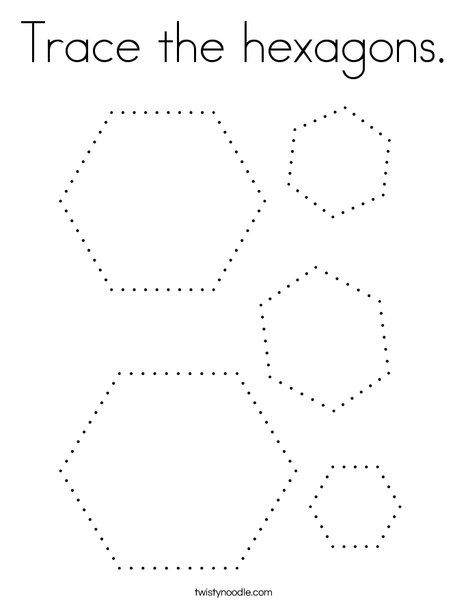
In educational settings, the shape hexagon worksheet functions as a versatile resource that caters to diverse learning stages. For young students in kindergarten or first grade, these exercises often involve coloring, tracing, and basic counting activities designed to build familiarity with the form. As learners progress, the complexity of the tasks evolves to include calculating interior angles, determining the perimeter of regular and irregular hexagons, and calculating the area. This tiered structure ensures that the material remains accessible and challenging in equal measure, fostering a genuine comprehension of the concept rather than mere rote memorization.
Core Components of a Hexagon Learning Worksheet
A truly effective shape hexagon worksheet is meticulously designed to guide the learner through a logical progression of skills. Typically, the exercises are organized to start with the most fundamental attribute recognition and gradually increase in difficulty. The goal is to transform a passive shape into an object of active analysis, prompting the student to engage with its mathematical and visual properties. Below is a breakdown of the common elements you will find in a high-quality worksheet.


Identification and Classification
Worksheets always begin with the essential skill of identification. Learners are presented with a variety of polygons and must isolate the hexagons from circles, squares, triangles, and other shapes. Advanced versions might ask students to distinguish between regular hexagons, where all sides and angles are equal, and irregular hexagons, where variations occur. This initial step is critical for building the visual vocabulary necessary for more complex calculations and applications.
Symmetry and Tessellation Exploration
One of the most fascinating properties of the hexagon is its ability to tessellate, or tile a plane perfectly without any gaps. A comprehensive shape hexagon worksheet will almost certainly include exercises on symmetry lines and tessellation patterns. Students are often tasked with drawing lines of symmetry—of which a regular hexagon has six—or using the shape to create intricate mosaic-like designs. These activities highlight the efficiency and beauty of the hexagon, linking geometry to real-world architecture and natural phenomena.


Practical Applications and Advanced Problems
To solidify the relevance of the shape, quality worksheets incorporate practical application questions that move the exercise beyond the theoretical. This section prompts students to calculate the perimeter by summing the lengths of six sides or to apply the specific formula for the area of a regular hexagon, often presented as \(\frac{3\sqrt{3}}{2} s^2\). These problems require the learner to not just recognize the shape but to manipulate its measurements, bridging the gap between visual learning and mathematical problem-solving.
Critical Thinking and Real-World Context
Exceptional worksheets avoid being mere collections of problems and instead integrate critical thinking prompts. A question might ask a student to analyze a honeycomb structure and explain why hexagons are the most efficient shape for storing honey, connecting geometry to biology and engineering. Others might present a real-world scenario, such as planning a garden layout or designing a nut and bolt, requiring the student to visualize and utilize the properties of the hexagon to find a solution. This context ensures that the knowledge gained is durable and meaningful.
Ultimately, the shape hexagon worksheet is far more than a simple classroom exercise; it is a foundational tool that cultivates analytical thinking and spatial reasoning. By engaging with these structured activities, students develop a nuanced understanding of geometric principles that prepare them for higher-level mathematics and scientific inquiry. The ability to dissect, analyze, and recreate the hexagon translates into a tangible confidence in navigating the geometric world.




Related Articles

Oval Shape Tracing Worksheet: Free Printable Activities for Kids
An oval shape tracing worksheet serves as a foundational tool in early childhood education, bridging the gap between playful activity and essential skill...

KG Class Ke Liye Worksheet – Free Printable Activities for Kids
For educators and parents navigating the early stages of mathematical development, the kg class ke liye worksheet serves as an essential foundational tool. In...

Fun Shape Worksheets for Pre K Kids – Free Printable Activities
Shape worksheets for pre K children represent a foundational pillar in early childhood education, bridging the gap between playful exploration and structured...
Fun Shapes Drawing for Kids Worksheet – Free Printable Activities
Introducing shapes drawing for kids worksheet activities is one of the most effective ways to build a strong visual foundation for early learners. These...

Fun Shape Coloring Pages for Kids: Free Printable Activities
Shape coloring pages for kids transform abstract geometric concepts into a tangible celebration of color and form. By filling the outlines of a circle, square...
Shape Tracing Sheets: Free Printable Activities for Kids
Mastering the fundamentals of writing and geometry begins long before a child holds a pencil with formal instruction. A shapes tracing sheet serves as a...