Master the Russian Alphabet Letters and Sounds: A Complete Guide
The Russian alphabet, known as Cyrillic, presents a fascinating first step for anyone beginning to learn the language. While it may look intimidating at first glance, with its unfamiliar letters and curves, the core principle is straightforward: each symbol represents a distinct sound. Unlike languages that use the Latin script, Russian offers a largely phonetic system where what you see is often what you get. This consistency between spelling and pronunciation is a significant advantage for learners, reducing the guesswork involved found in other languages. Mastering this script is less about memorizing strange drawings and more about understanding a new set of sounds that already exist in your mouth.
Understanding the Origins of Cyrillic
The history behind the Russian script adds a rich layer of context to the learning process. Developed during the First Bulgarian Empire in the late 9th century, the Cyrillic script was likely created by the disciples of Saints Cyril and Methodius, who adapted the Greek alphabet to accommodate the specific sounds of the Slavic languages. This origin is crucial to understanding why the alphabet looks the way it does. Many letters are direct cousins to their Latin counterparts, sharing not just shape but also historical lineage. Recognizing these connections can ease the psychological barrier, transforming the alphabet from a foreign script into a historical relative you are just getting to know.
The Structural Breakdown: Vowels and Consonants
To truly grasp the mechanics of the language, it is essential to move beyond viewing the alphabet as a wall of strange symbols and instead categorize the letters by their function. The system is built upon a balance of vowels and consonants, working together to form syllables. While there are nuances regarding softness and hardness, the fundamental division is clear. Learning the categories helps in understanding word structure and pronunciation rules. Here is a table outlining the primary classifications of the Russian vowels.


| Category | Letters | Approximate Sound |
|---|---|---|
| Hard Vowels | а, о, у, э | ah, oh, oo, e (as in pet) |
| Soft Vowels | е, ё, ю, я | yeh, yo, yoo, yah |
| Neutral Vowels | и, ы | ee, ih (like i in ill) |
Navigating the Tricky Consonants
While the vowels provide the melody of the language, the consonants form the skeleton of the words, and several of them come with a critical distinction that does not exist in English: softness. The same letter, such as "т" (t) or "с" (s), can be pronounced either hard or soft depending on the vowel that follows it. The soft vowels (е, ё, ю, я) act as a switch, forcing the preceding consonant to be pronounced with the tongue raised toward the roof of the mouth. This subtle shift in tongue position creates a distinctly different sound. For example, the "т" in "тетрадь" (notebook) is soft, while the "т" in "том" (volume) is hard. Treating these two versions as separate sounds is essential for achieving an authentic Russian accent.
Confronting the False Friends
One of the most common pitfalls for English speakers learning Russian is the presence of "false friends." These are letters that look exactly like Latin letters but speak a completely different phonetic language. Relying on your intuition based on the Roman alphabet will lead to immediate mispronunciation. For instance, the letter "В" is a "V" sound, not a "B"; the "У" is a "oo" sound as in "food"; and the "А" is pronounced like the "a" in "father." Conversely, the letter "Р" is an "R" sound, and "С" is an "S." These visual traps are responsible for many humorous missteps, so it is vital to memorize the sounds of the Cyrillic characters independently of their Latin lookalikes.


The Rhythm of the Hard Sign and Soft Sign
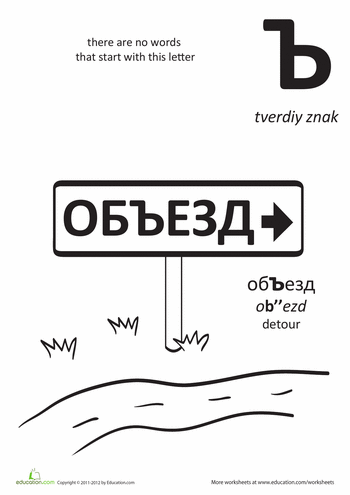
Amidst the alphabet, two special characters act as silent modifiers rather than carriers of sound: the Hard Sign (ъ) and the Soft Sign (ь). The Hard Sign does not produce a vowel sound but acts as a barrier, ensuring that the consonant before it remains hard, even if followed by a soft vowel. The Soft Sign, on the other hand, serves as a gentle nudge, softening the consonant that precedes it, much as if an invisible "е" were attached. These signs are crucial for proper spelling and meaning, as they change how a word is parsed phonetically. While they are silent, their role in structuring the rhythm and clarity of Russian speech is indispensable.
From Symbols to Sound: Practical Tips
Transitioning from recognizing letters to producing sounds requires a specific strategy focused on audio training. Because the visual map is so different from English, trying to "read" the word as you would in your native tongue is counterproductive. Instead, learners should focus on associating the shape with the sound immediately, bypassing the Latin alphabet entirely. Listening to native speakers and mimicking the intonation is vital. Pay close attention to the rolling "Р" and the distinct "Г" (G or gh sound). Consistent practice with the auditory component, rather than just visual memorization, is the fastest way to build fluency in reading Russian aloud.
Embracing the Journey
Learning the Russian alphabet is more than a mechanical exercise; it is an entry into the logic of a different linguistic world. The combination of phonetic consistency, historical depth, and unique characters like the soft signs creates a system that is challenging yet highly logical. By understanding the distinctions between hard and soft sounds, avoiding the pitfalls of false friends, and respecting the roles of the silent modifiers, the seemingly impossible task of deciphering Cyrillic becomes an achievable goal. Approach the letters not as obstacles, but as the building blocks that will unlock the rich sounds and stories of the Russian language.




Related Articles

Master the Hebrew Alphabet Letters A to Z: A Complete Visual Guide
The Hebrew alphabet, known as the Aleph-Bet, serves as the foundational building block for reading, writing, and understanding the Hebrew language. This script...
Master the Russian Lowercase Alphabet: A Complete Guide
The russian lowercase alphabet forms the foundational building blocks of the Cyrillic script, essential for writing the Russian language. While it shares a...
Master the Small Letter Russian Alphabet: A Complete Guide
The small letter Russian alphabet forms the foundational building block for written communication in the Russian language. While the script may appear complex...

Master the Russian Alphabet and Letters: Your Ultimate Guide
The Russian alphabet is more than a sequence of symbols used to write the language; it is a foundational element of Russian history, culture, and linguistic...

Master Russian Alphabet Print and Cursive: A Complete Visual Guide
Understanding the Russian alphabet in both print and cursive forms is essential for anyone serious about learning the Russian language. While the phonetic...
Master the Russian Alphabet Letters A to Z: Your Ultimate Guide
Understanding the Russian alphabet letters a to z is the essential first step for anyone embarking on the journey of learning Russian. While the script may...