Master Number Doubles: Fun Worksheet Practice
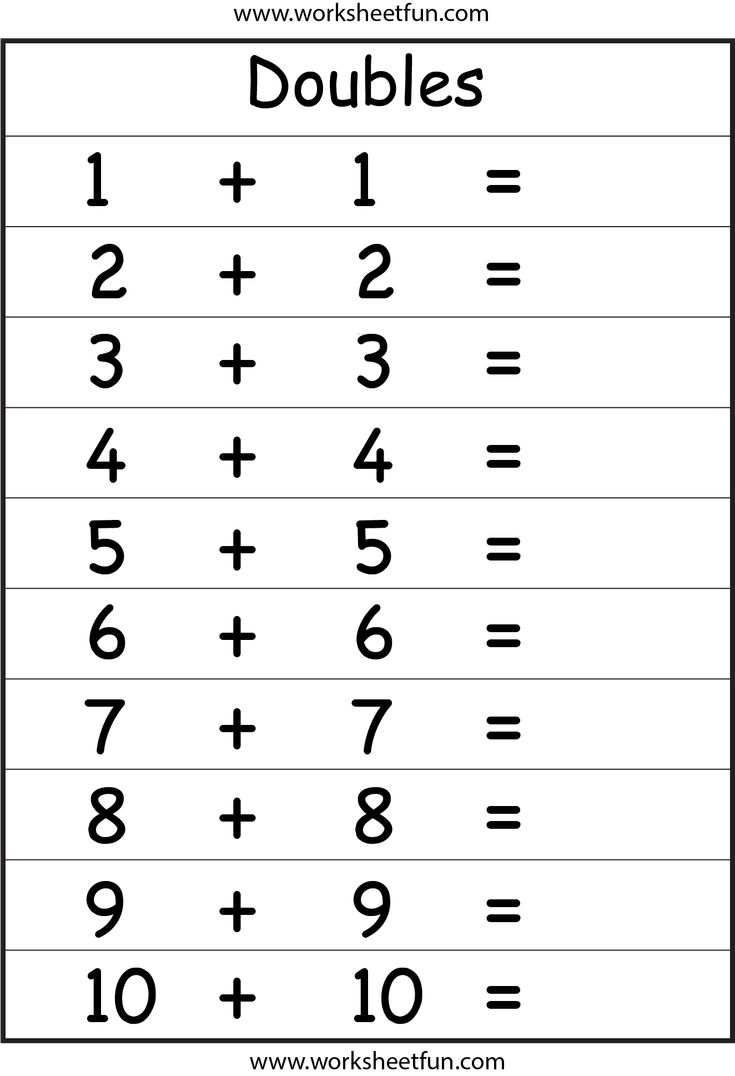
Mastering foundational arithmetic is the bedrock of advanced mathematical understanding, and one of the most effective tools for building this foundation is the number doubles worksheet. This specific type of exercise focuses on the essential skill of doubling numbers, a concept that serves as a cornerstone for multiplication, mental math, and numerical fluency. By engaging with these targeted problems, students move beyond simple counting and begin to develop a deeper number sense, allowing them to visualize numerical relationships and solve problems with greater speed and accuracy.
The Core Concept Behind Doubles Facts
At its heart, a number doubles worksheet presents students with the task of adding a number to itself, such as 6 + 6 or 9 + 9. This might seem like a simple exercise, but it encapsulates a powerful mathematical principle: the structure of our base-10 number system relies heavily on these symmetrical relationships. Unlike random addition problems, doubles offer a predictable pattern where the sum is always an even number, and the digits often follow a logical sequence. This predictability is precisely why educators emphasize these facts; they provide a stable framework upon which more complex calculations can be built, reducing the cognitive load required for mental computations.
Benefits for Mental Math Development
One of the primary advantages of using a number doubles worksheet is the significant boost it provides to mental math abilities. When students memorize that 7 + 7 equals 14, they are not just storing a random fact; they are creating a mental anchor. This anchor allows them to quickly deduce other related facts. For instance, if a student knows that 7 + 7 is 14, they can easily figure out that 7 + 8 is 15 by simply adding one more. This strategy of using doubles as a launching pad for nearby facts is a critical component of efficient numerical reasoning, transforming slow counting into instant recall.


Structured Practice and Repetition
Learning is often the result of deliberate practice, and a number doubles worksheet provides the ideal structure for this repetition. The format is consistent, usually featuring a vertical list of problems that focus exclusively on the doubles. This singular focus eliminates distractions and allows the student to concentrate solely on the task at hand. The repetitive nature of the exercise reinforces the neural pathways associated with these specific sums, moving the knowledge from short-term memory to long-term memory. Over time, the act of doubling becomes an automatic response, freeing up mental energy for more sophisticated problem-solving tasks.
Progressive Difficulty and Variations
While the concept is simple, a well-designed number doubles worksheet can incorporate progressive difficulty to challenge learners at different stages. Basic worksheets might cover numbers 1 through 10, suitable for kindergarten or first-grade students. More advanced versions can extend into the double-digits, such as 12 + 12 or 24 + 24, catering to older children or those ready for a greater challenge. Furthermore, educators often utilize variations like "doubles plus one" or "doubles minus one" (e.g., 5 + 6 or 5 + 4) to help students bridge the gap between pure memorization and flexible application, ensuring a comprehensive grasp of numerical relationships.


Application in Real-World Scenarios
The utility of knowing number doubles extends far beyond the classroom walls and into everyday life. These facts are essential for tasks such as calculating quantities—doubling a recipe requires knowing that 2 cups plus 2 cups equals 4 cups—or quickly determining costs when buying items in pairs. In a financial context, understanding that 20 doubled is 40 can help in visualizing budget allocations or comparing prices. By mastering these facts through a number doubles worksheet, individuals develop a practical tool for navigating the numerical demands of daily life with confidence and efficiency.
Integration with Modern Learning Tools
Traditional paper-based number doubles worksheets remain highly effective, but they have also seamlessly integrated with digital learning platforms. Many educational apps and online learning management systems utilize the same principles, presenting doubles problems in interactive formats that include instant feedback, gamified elements, and progress tracking. This combination of classic pedagogy with modern technology allows students to practice anywhere, anytime, turning what could be枯燥 drills into engaging activities. The core objective remains the same: to solidify these essential numerical building blocks through consistent and interactive practice.


Related Articles

Adding and Subtracting Angles Worksheet PDF: Master Geometry Practice
Mastering the fundamentals of geometry requires a solid grasp of angle manipulation, and a dedicated adding and subtracting angles worksheet PDF is the most...

Fun Number Worksheets 1-20: Tracing, Counting & Writing Practice
Mastering the fundamentals of arithmetic begins with a solid grasp of the numbers that form the bedrock of all mathematics. The worksheet about numbers 1 20...

Trace and Learn: Number Tracing 1 to 50 Worksheet Practice
Mastering numerical order is a foundational skill that empowers young learners to navigate mathematics with confidence. A tracing numbers 1 to 50 worksheet...

Master Negative Numbers: Adding & Subtracting Worksheet Practice
Mastering the worksheet negative numbers adding subtracting process is a fundamental milestone in a student's mathematical journey. This critical skill moves...

Free Spell Master: Instant Spelling Worksheet Generator for Smart Practice
For educators and parents constantly searching for effective ways to build foundational literacy skills, the humble spelling worksheet generator has become an...

Master Addition & Subtraction Borrowing: Easy Practice Worksheets
Mastering the fundamental operations of arithmetic is the cornerstone of mathematical proficiency, and within this foundation, the concepts of addition and...