lowercase letter in hindi छोटे अक्षर हिंदी में शब्द बनाने का सही तरीकाgado
Understanding the lowercase letter in Hindi is fundamental for anyone beginning their journey into the Devanagari script. While the script is often associated with its distinctive, flowing uppercase forms, the subtle variations in writing lowercase letters play a critical role in achieving authentic fluency. This exploration moves beyond simple memorization to examine how these characters function within the structural grammar of the language.
The Structure of Devanagari Characters
At its core, the Hindi script is built upon a systematic arrangement known as the "akshar" or syllabic unit. Unlike the Latin alphabet where letters float independently, most characters in Hindi are built from a horizontal top line, or "shirorekha." This foundational line is the backbone of the script, and understanding how the lowercase forms interact with it is essential for clear handwriting.
When writing a lowercase letter in Hindi, the pen rarely lifts from the page. The strokes flow in specific directions—typically from left to right—to create compact, connected symbols. This continuity is what gives Devanagari its unique, rhythmic appearance, distinguishing it from scripts that feature distinct, separated block letters.


Lowercase Forms of Vowels
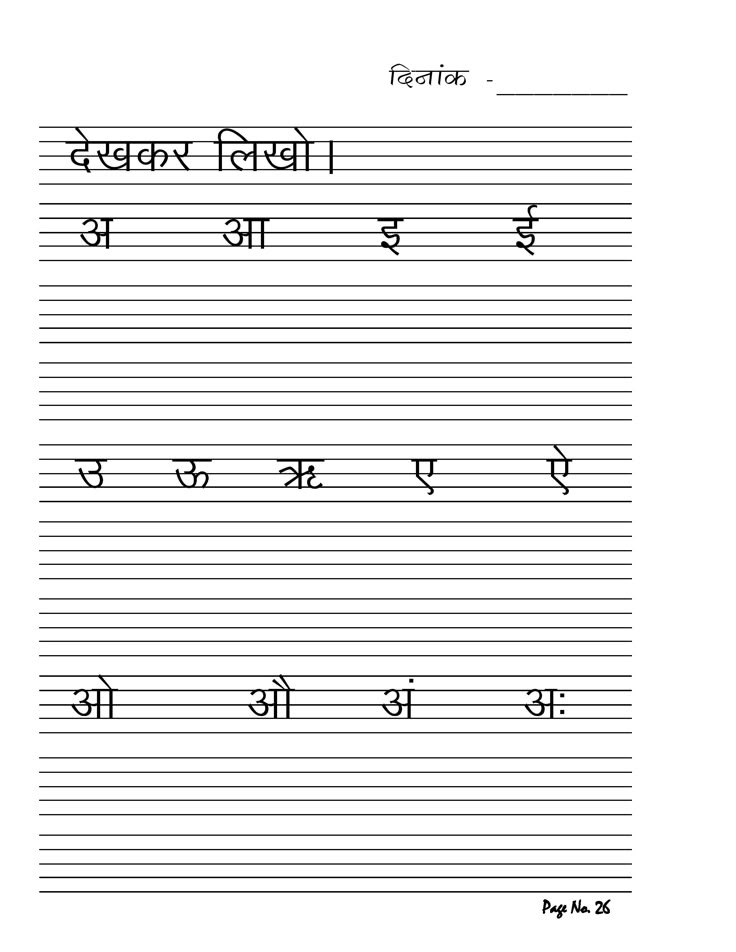
The vowel sounds, or "swar," present a unique challenge because their appearance changes dramatically based on their position in a word. In isolation, the vowel "A" (अ) is a distinct symbol; however, when it acts as a "matra" (vowel sign) for lowercase modifiers, it becomes a small horizontal line attached to the main consonant.
- The short "A" (अ) is the default sound, represented by a simple loop below the shirorekha.
- The "I" sound (इ) is written as a small vertical line extending leftward from the top line.
- The elongated "E" (ए) appears as a distinct curve that branches off the main structure, similar to a lowercase script "l".
Consonants and the Role of the Halant
Consonants form the skeleton of Hindi writing, and their lowercase versions are immediately recognizable by their elaborate curves. To prevent the language from becoming a monotonous wall of connected lines, the "halant" sign (्) is introduced. This symbol acts as a silent separator, indicating that the consonant should not carry a default vowel sound.


When a lowercase consonant is followed by a halant, it appears stark and efficient, shedding the curve that usually connects it to the next letter. This technique is vital for writing words with final consonants or creating the hard, clipped sounds that define the language's rhythm.
Nuances in Cursive Flow
One of the most elegant aspects of the lowercase letter in Hindi is the "half form." Many consonants dramatically simplify their structure when they appear at the beginning of a syllable or in combination. For example, the letter "क" (ka) shrinks to a minimalist hook when it precedes another consonant, allowing the script to maintain a consistent height and flow without the vertical baggage of the full form.
This cursive nature requires a different motor skill than printing block letters. The writer must develop a sense of timing and connection, ensuring that the loops are closed and the lines are connected seamlessly to preserve the integrity of the script.


Practical Application and Digital Rendering
In the digital age, the distinction between uppercase and lowercase Hindi letters extends beyond pen and paper. Font design plays a significant role in readability. A well-crafted typeface ensures that the lowercase matras—the vowel signs—are positioned at the correct altitude, aligning perfectly with the main consonant without crowding the ascenders or descenders.
Furthermore, software rendering must handle the complex ligatures of Devanagari. When typing rapidly, the computer must calculate how to join the lowercase shapes correctly, a process that relies on extensive Unicode mapping to ensure that the characters connect smoothly rather than overlapping chaotically.
Comparison Chart: Uppercase vs. Lowercase Forms
| English Sound | Uppercase/Isolated Form | Lowercase/Cursive Form | Description of Change |
|---|---|---|---|
| A | अ (Distinct symbol) | ा (Matra) | Becomes a horizontal line attached to the consonant. |
| T | ट (Full loop) | ट् (Halant form) | Stripped of connecting curve to indicate a dead consonant. |
| K | क (Full vertical) | क (Half form) | Simplified to a hook for easier linking with subsequent letters. |
Mastering the lowercase letter in Hindi is ultimately about embracing the script's fluidity. It is a transition from rigid, textbook examples to the dynamic reality of conversational writing. By appreciating the subtle curves and connections, learners unlock the true speed and beauty of the Devanagari script, moving one step closer to thinking in Hindi rather than just translating it.




Related Articles
lowercase letters meaning in hindi: छोटे हीरों का मतलब हिंदी में
Understanding the interpretation of lowercase letters meaning in Hindi requires navigating the distinct characteristics of the Devanagari script. While the...
lowercase letter hindi meaning छोटा अक्षर हिंदी अर्थ
Understanding the lowercase letter Hindi meaning requires looking beyond a simple translation. In the Devanagari script, every character is a precise...
Trace Letter Hindi Meaning: अक्षर छाप का हिंदी अर्थ और ऑटोट्रेस गाइड
Understanding the trace letter Hindi meaning is essential for anyone embarking on the journey of learning Devanagari script. This specific component of the...

हिंदी में अक्षर, संख्या और प्रतीकों का मिश्रण: SEO फ्रेंडली शीर्षक
इस digital दुनिया में, जहाँ हम प्राथमिक रूप से smartphones, computers, और various online platforms के माध्यम से जुड़े रहते हैं, हमारे पास जितने भी डेटा होते...
Small Letter Alphabet in Hindi: A to Z छोटे अक्षर Shorthand Chart, Pronunciation & Writing Guide
Understanding the small letter alphabet in Hindi is fundamental to grasping the Devanagari script, the writing system used for Hindi and several other Indian...
lowercase letter hindi font style सुंदर शब्द
Understanding the lowercase letter Hindi script is essential for anyone beginning their journey into the Devanagari script. While the language itself is rich...