Chinese Numbers Tracing Worksheet: Learn to Write 1-10
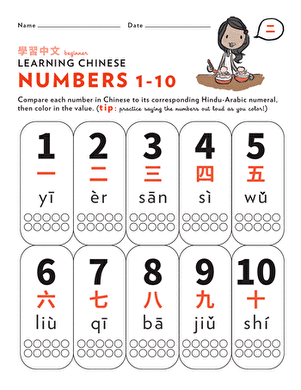
Mastering the foundational elements of language and mathematics often begins with the simplest tools, and for young learners, few resources are as effective as a dedicated Chinese numbers tracing worksheet. This specific educational tool bridges the gap between abstract numerals and muscle memory, allowing children to physically map the unique strokes that form the Chinese number system. By engaging in this repetitive yet purposeful action, students build a solid groundwork for future proficiency in reading, writing, and counting in Mandarin.
The Structure of Chinese Numerals
The Chinese number system is celebrated for its logical and consistent structure, particularly within the basic ten digits. Unlike the varied shapes of Western numerals, each Chinese numeral from zero to nine is built from a distinct combination of strokes, adhering to strict stroke order rules. A proper Chinese numbers tracing worksheet highlights these components, breaking down complex shapes into manageable segments. This systematic approach ensures that learners understand not just the final form of the number, but the sequence of lines required to create it, fostering a deep, structural understanding rather than simple rote memorization.
Benefits of Tracing for Muscle Memory
Tracing is far more than a simple copying exercise; it is a neurological and physical training method that ingrains motor patterns. For children developing fine motor skills, the guided path of a tracing line helps coordinate hand-eye movement and pencil grip. A well-designed worksheet provides the necessary scaffolding, allowing the hand to learn the rhythm of writing a "八" (eight) or a "十" (ten) until the motion feels natural. This muscle memory is crucial because it frees up cognitive energy, allowing the learner to focus on the meaning and application of the number rather than the physical struggle of forming it.


Integration with Pronunciation and Quantity
An exceptional Chinese numbers tracing worksheet does not exist in a vacuum. It serves as a multifaceted platform that integrates visual recognition, written production, and auditory learning. Educators and parents can easily pair the act of tracing with verbal pronunciation, helping students connect the written symbol with its phonetic sound. Furthermore, these worksheets often incorporate counting exercises or simple pictograms, reinforcing the concept that the abstract symbol represents a specific quantity. This holistic approach ensures that the number "五" (five) is understood as a sound, a written word, and a concrete amount, solidifying the learning comprehensively.
Design Elements for Effective Learning
The effectiveness of a tracing worksheet is heavily dependent on its design and clarity. High-quality worksheets utilize a large, uncluttered format with ample spacing between characters to prevent visual crowding. They often feature color-coded stroke guides, such as red for the starting point and directional arrows, to guide the pencil path accurately. Look for a worksheet that includes numbered strokes; this detail is vital for teaching the correct sequence, which impacts the speed and legibility of the final handwriting. A good design minimizes frustration and maximizes engagement for the young writer.


Practical Applications in the Classroom and Home
Whether in a bustling language school or a quiet home study room, the versatility of the Chinese numbers tracing worksheet makes it an indispensable resource. Teachers can utilize them for individual seat work or as part of a structured group activity, ensuring every student receives targeted practice. For parents supporting their child's bilingual education, these worksheets offer a simple yet powerful way to supplement learning at home. They provide a tangible sense of progress as the child’s handwriting improves over weeks, offering a visible record of their journey toward mastering Mandarin numeracy.
Progression and Mastery
Learning to write Chinese numbers is a journey that moves from guided replication to independent creation. A structured curriculum will utilize the tracing worksheet as the initial step, gradually transitioning to dotted lines, then dashed lines, and finally blank space for the student to recall the character unaided. This staged progression builds confidence and ensures that the skill is internalized. Mastery is achieved when the student can fluidly write the numbers without hesitation, allowing them to advance to more complex mathematical operations, such as addition and subtraction, entirely in Chinese.




Related Articles

Trace and Learn: Number Tracing 1 to 50 Worksheet Practice
Mastering numerical order is a foundational skill that empowers young learners to navigate mathematics with confidence. A tracing numbers 1 to 50 worksheet...

Trace and Write Numbers 1-10 Worksheets: Free Printable Practice for Kids
Mastering the fundamentals of mathematics begins with understanding quantity and symbol association, a skill honed through consistent practice with tracing and...

Trace & Triumph: 1-10 Number Tracing Worksheets for Little Learners
For educators and parents guiding early learners, the tracing numbers 1 10 worksheet serves as a fundamental building block in numeracy development. This...

Number 5 Tracing Worksheet: Practice Writing Numbers 1-10
Mastering the numeral 5 is a foundational milestone in a child's mathematical journey, and a tracing worksheet of number 5 provides the perfectStructured...

Trace & Learn: Numbers 1-10 with Pictures PDF for Kids
Tracing numbers 1 10 with pictures PDF resources have become an essential tool for early childhood education, providing a structured and visual approach to...
Master Numbers 1-10: Fun Tracing Worksheets for Kids
Mastering the foundational skill of number formation is a critical milestone in early childhood education, and the numbers tracing worksheet 1 10 serves as the...