Chinese Number Tracing Worksheet: Practice 1-10 for Kids
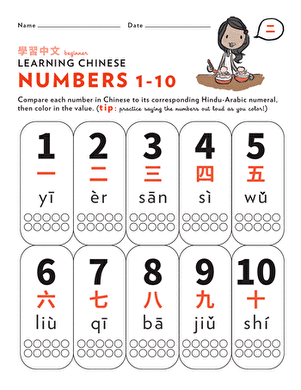
Mastering the fundamentals of mathematics often begins with the simplest of exercises, and few tools are as effective for young learners as the chinese number tracing worksheet. This foundational method transforms the abstract concept of numerical symbols into a tactile experience, bridging the gap between visual recognition and motor skill development. For educators and parents seeking to build a robust mathematical groundwork for children, understanding the structure and application of these worksheets is essential.
Understanding the Structure of Chinese Number Tracing
A chinese number tracing worksheet is meticulously designed to guide the hand through the precise stroke order of each numeral. Unlike standard Western numerals, the characters for numbers one through ten follow specific directional rules, starting at particular points and moving in a defined sequence. The worksheet typically presents a grid where the correct stroke order is illustrated with numbered arrows or faded guide lines, ensuring that practice leads to perfect form from the very first attempt.
Stroke Order and Cultural Significance
The importance of stroke order cannot be overstated, as it is deeply rooted in the logic of Chinese character construction. Practicing with a structured worksheet instills discipline and respect for the language's history. Each numeral is a radical in itself, and the consistent practice of these shapes reinforces muscle memory that proves invaluable when children progress to learning more complex characters. This early exposure cultivates an intuitive understanding of how Chinese writing flows.


The Educational Advantages for Young Learners
Beyond mere memorization, the chinese number tracing worksheet serves as a multi-sensory learning instrument. Children engage their visual cortex by observing the model, their kinesthetic sense by controlling the pencil, and their cognitive abilities by processing the sequence. This combination of sensory inputs creates strong neural pathways, making the recall of numerical symbols almost automatic and significantly reducing the frustration often associated with early math education.
- Develops pre-writing skills and pencil grip.
- Enhances number recognition and sequencing abilities.
- Builds confidence through repetitive, successful practice.
- Introduces learners to the logical structure of the Chinese language.
Integration into Modern Learning Environments
In today's classroom, the chinese number tracing worksheet easily integrates with digital learning tools. Educators can project the worksheets onto smart boards for group instruction, allowing students to follow along in real-time. Furthermore, these worksheets complement digital apps; the physical act of tracing on paper provides a necessary counterbalance to screen time, ensuring that children develop a balanced set of skills that are both digital and tactile.


Customization and Practical Application
One of the greatest strengths of this resource is its versatility. Teachers can select worksheets focusing on specific numbers that a class finds challenging, or use a comprehensive sheet to review all characters at once. Parents looking for supplemental material at home will find that a simple tracing session offers a quiet, focused activity that reinforces school-taught lessons without feeling like additional homework. The goal is always the same: to make the written language accessible and intuitive.
Evaluating Progress and Mastery
To determine the effectiveness of the exercise, educators and parents can utilize the blank grid sections often found at the bottom of a chinese number tracing worksheet. By observing a child attempt to replicate the numbers without guide lines, one can assess true retention. Mastery is evident when the child can produce the characters confidently and correctly without the scaffolding of tracing, indicating that the knowledge has moved from short-term memory to long-term competency.


Related Articles

Fun Number Tracing Worksheet for Kids: Practice 1-10!
Number tracing worksheets for kids represent a foundational tool in early childhood education, bridging the gap between abstract numeracy and physical writing...

Fun Number 3 Worksheet for Nursery Kids – Tracing, Counting & Coloring Practice
Number 3 worksheets for nursery kids represent a fundamental building block in early childhood mathematics education. These carefully designed activities...

Number 5 Tracing Worksheet: Practice Writing Numbers 1-10
Mastering the numeral 5 is a foundational milestone in a child's mathematical journey, and a tracing worksheet of number 5 provides the perfectStructured...

Fun Number Tracing Worksheets 1-10: Free Printable Practice for Kids
Number tracing worksheets 1 to 10 serve as the foundational building blocks for early mathematical literacy, offering a structured and tactile approach to...

Fun Number Writing Practice for Kids: Tracing Numbers 1-10
For many young learners, the journey toward mathematical literacy begins not with complex equations, but with the simple, deliberate act of writing numbers...

Trace and Learn: Number Tracing Worksheets 1-10 for Kids
Mastering the fundamentals of mathematics begins with understanding the language of numbers, and for young learners, this journey starts with the tangible...