Before and After Number Worksheet for Senior KG: Fun Math Practice
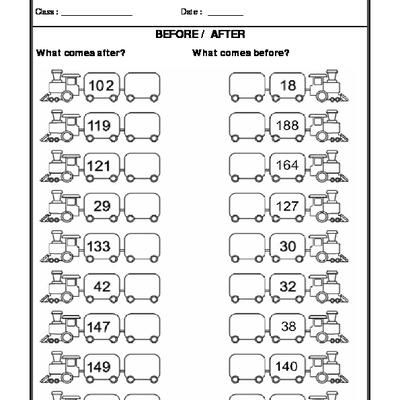
Before and after number worksheets for Senior Kindergarten represent a foundational educational tool designed to solidify a child’s understanding of numerical sequence. This specific exercise moves beyond simple rote counting, compelling young learners to visualize the structure of number lines and the logical progression of mathematics. By identifying the number that precedes or follows a given digit, children develop critical思维 skills, establishing a concrete grasp of quantity and order that is essential for all future arithmetic operations.
Understanding the Concept of Numerical Sequence
The core objective of the before and after activity is to instill a deep comprehension of numerical sequence, moving beyond memorization to actual reasoning. In Senior KG, children are typically working with numbers up to 20 or 30, a range that is complex enough to require thought but simple enough to manage with guided practice. This worksheet format visually presents a number and asks the student to determine the integer that comes immediately before (predecessor) or after (successor). This process reinforces the abstract concept that numbers are not isolated symbols but part of a continuous, ordered system.
The Role of Predecessor and Successor
Breaking down the task into identifying the predecessor and successor helps children analyze numbers individually. The "before" number worksheet focuses on backward counting, enhancing a child's ability to subtract one mentally and understand the concept of "less than." Conversely, the "after" number worksheet focuses on forward counting, building the foundation for addition and the understanding of "greater than." Mastery of both directions ensures that a child is not just counting up from one, but truly understands the relationship between every pair of numbers.


Educational and Cognitive Benefits
Utilizing a before and after number worksheet offers benefits that extend far beyond the mathematics classroom. This exercise significantly strengthens number sense, which is the fluidity and flexibility with which children understand numbers. It also promotes the development of logical reasoning and problem-solving abilities, as the child must deduce the correct answer rather than simply recite a memorized list. Furthermore, it prepares the neurological pathways required for more complex operations like mental math and eventually, algebra.
- Enhances Number Recognition: Children quickly associate the written symbol with its position in the sequence.
- Develops Mental Math Skills: Establishes the basis for calculating quantities without the need for physical objects.
- Improves Concentration and Focus: The task requires careful attention to detail to identify the correct numerical neighbor.
- Builds Confidence: Successfully completing the sequence provides a sense of accomplishment and reinforces positive learning habits.
Practical Application in the Classroom
For educators, the before and after number worksheet is a versatile resource that can be integrated into various lesson plans. It functions effectively as a starter activity to review previous lessons or as a focused drill for students who need additional practice with specific numbers. Teachers can use these worksheets for guided group instruction, allowing them to observe and correct misconceptions in real-time, or as independent homework to assess individual student understanding. The structured nature of the exercise makes it easy to differentiate instruction; while some students work with numbers up to 10, others can be challenged with ranges up to 50.


Design and Visual Appeal for Young Learners
Senior Kindergarten learners respond exceptionally well to visually engaging materials, and a well-designed worksheet incorporates this principle. Bright colors, large numerals, and friendly graphics help maintain a child's attention and reduce the intimidation factor of academic work. A high-quality worksheet will feature ample spacing for writing, ensuring that little hands can form their numbers comfortably without cramping. The layout is typically straightforward, with a clear heading and simple instructions, allowing the child to focus solely on the numerical task at hand without becoming confused by excessive text or clutter.
Bridging the Gap to Formal Mathematics
Perhaps the most significant value of the before and after number worksheet lies in its ability to bridge the gap between concrete counting and abstract mathematics. When a child understands that the number after 7 is 8, they are implicitly understanding the concept of adding one. Similarly, knowing that the number before 12 is 11 builds the foundation for subtraction. This worksheet is not merely about filling in blanks; it is about constructing a robust mental framework for how the quantitative world is organized. This early introduction to sequence ensures that when children encounter formal number lines and arithmetic problems, they are not starting from scratch but are building upon a solid, intuitive understanding.




Related Articles

Before and After Number Worksheet for Kids: Free Kindergarten Math Practice
Number worksheets designed for kindergarten serve as a foundational tool for early numeracy development, and the "before and after" format specifically targets...

Before Number Worksheet for Senior KG: Free Pre-School Math Practice
Before number worksheet for senior kg serves as a critical bridge between playful preschool activities and structured early grade mathematics. These...
After Number Worksheet for Senior KG: Fun Math Practice for Kids
Mastering the sequence of numbers is a foundational skill for young learners in Senior Kindergarten, and the after number worksheet serves as an essential tool...

Kindergarten Math Worksheets: Before & After Number Practice (Free)
Kindergarten math worksheets focusing on the concepts of before and after provide a foundational bridge between intuitive number sense and formal mathematical...
Between Numbers Worksheet for Senior KG – Fun Math Practice for Little Learners
Mastering numerical order is a fundamental skill for young learners, and the between number worksheet for senior kg provides an ideal platform for this...
Before Number Worksheet for Class KG: Fun Early Math Practice
Before number worksheets for class kg serve as the foundational stepping stone for a child's mathematical journey. These specialized resources are designed to...