Alphabet Car Tracing: Fun Worksheets for Kids
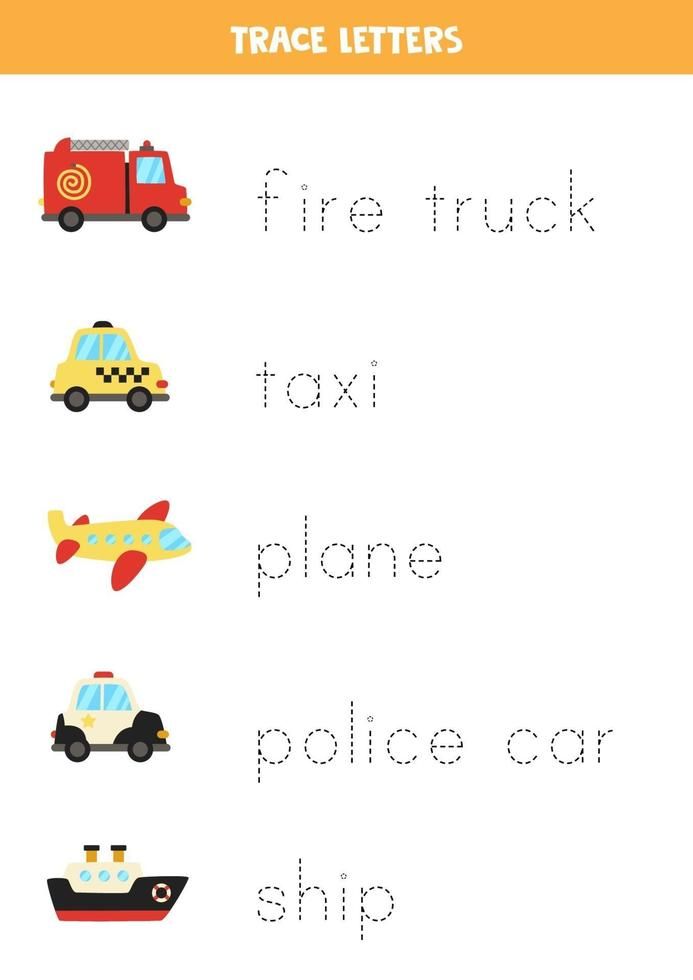
Alphabet car tracing represents a foundational exercise in early childhood development, bridging the gap between playful learning and essential academic skills. This method involves guiding a child's hand or a stylus through a pre-drawn sequence of letters, transforming abstract symbols into tangible pathways. By focusing on the building blocks of written language, this activity cultivates the muscle memory and cognitive recognition necessary for fluent reading and writing. It is a versatile tool, equally effective in a classroom setting or during quiet time at home, making it a staple for parents and educators alike.
The Cognitive Mechanics Behind Tracing
The effectiveness of alphabet car tracing lies in its engagement of multiple developmental domains simultaneously. This process is not merely about holding a pencil; it is a complex coordination of visual perception, fine motor control, and spatial reasoning. As a child follows the winding path of a letter, their brain processes the shape visually while their hand muscles execute the precise movements required. This dual-action reinforces neural pathways, leading to improved pencil grasp and the ability to form letters with consistent size and orientation.
From Lines to Letters: The Progression
Mastery of writing is a journey that follows a predictable sequence, and alphabet car tracing is the perfect vehicle for this progression. Children typically begin by developing the gross motor skills needed to draw vertical and horizontal lines. Once these foundational strokes are secure, the introduction of curved lines and simple shapes paves the way for letter formation. Alphabet tracing sheets often start with large, traceable characters, gradually reducing the size and increasing the complexity as the child's precision improves, ensuring a solid and confident transition to independent writing.


Integrating Play into Learning
One of the greatest strengths of alphabet car tracing is its inherent ability to merge education with entertainment. The rigid nature of repetitive drills can quickly disinterest a young learner, but tracing feels like a game. By framing the activity as "driving" a letter through a designated route, educators inject an element of narrative and fun. This shift in perspective transforms a potentially tedious task into an engaging adventure, fostering a positive association with learning that is crucial for long-term academic success.
Customization for Diverse Learners
Every child learns at their own pace, and alphabet car tracing offers remarkable flexibility to accommodate different needs and abilities. For the visual learner, brightly colored guides and directional arrows provide clear cues. For the kinesthetic learner, textured letters that can be traced with a finger offer a sensory-rich experience. Furthermore, these exercises can be easily tailored to focus on specific letters a child is struggling with, allowing for targeted practice rather than a one-size-fits-all approach. This adaptability ensures that the activity remains effective and inclusive for the entire spectrum of young learners.


Building the Foundation for Literacy
Beyond the immediate skill of writing, alphabet car tracing plays a pivotal role in establishing broader literacy fundamentals. The act of recognizing and replicating letter shapes directly correlates with phonemic awareness—the ability to identify and manipulate the sounds within words. By consistently encountering the letter "A" while tracing, a child begins to associate that symbol with its corresponding sound. This early connection is the bedrock upon which reading fluency and spelling competency are built, making tracing an indispensable step in the literacy journey.
Practical Tips for Implementation
To maximize the benefits of alphabet car tracing, incorporating a few best practices can significantly enhance the experience. Consistent practice, even for just a few minutes daily, is far more effective than infrequent, lengthy sessions. Providing immediate, positive feedback helps to build confidence and encourages repetition. Additionally, combining tracing with verbalization—such as sounding out the letter as it is written—creates a multi-sensory learning loop that dramatically improves retention and understanding.
| Benefit Area | Specific Skill Developed | Long-Term Impact |
|---|---|---|
| Motor Skills | Pencil Grasp & Hand-Eye Coordination | Improved writing legibility and endurance |
| Cognitive Development | Letter Recognition & Sequencing | Enhanced reading fluency and spelling accuracy |
| Academic Preparedness | Pre-writing & Visual Perception | Stronger foundation for future academic success |




Related Articles

Alphabet Tracing Q: Fun Worksheets for Kids
Mastering the foundational elements of written language often begins with the simplest exercises, and nowhere is this more apparent than with alphabet tracing...

Apple Alphabet Printables: Free Tracing Worksheets for Kids
Parents and educators seeking engaging early learning tools often turn to apple alphabet printables, a versatile resource for teaching letter recognition and...

Alphabet Tracing Letters A-Z PDF Download – Fun Worksheets for Kids
Mastering the fundamentals of written language begins with the smallest details, and for young learners, that often starts with the humble alphabet. Our...

Trace the Alphabet: A to Z Tracing Worksheets for Kids
Mastering the foundational building blocks of written language begins with the simplest unit of text, and for the Latin alphabet, that is the letter A to Z...

Tracing Letters for Kids PDF: Fun, Free Printable Worksheets for Little Learners
Tracing letters for kids PDF resources have become an essential tool for parents and educators introducing children to the fundamentals of writing. These...

Mickey Mouse Alphabet Printables: Fun Disney Worksheets for Kids
For parents and educators seeking engaging tools to introduce the fundamentals of reading, Mickey Mouse alphabet printables present a timeless and effective...